 Chaire UNESCO Alimentations du monde
Vers une gouvernance publique du commerce équitable ?
Accueil > Mots-clés > Type de ressource > Rapport/synthèse
Rapport/synthèse
Articles
-
 Héloïse Billot
2 juillet 2020, par Mathilde COUDRAY -
 Dietary diversity as a household food security indicator
3 novembre 2021, par Mathilde COUDRAYHousehold food security is an important measure of well-being. Although it may not encapsulate all dimensions of poverty, the inability of households to obtain access to enough food for an active, healthy life is surely an important component of their poverty. Accordingly, devising an appropriate measure of food security outcomes is useful in order to identify the food insecure, assess the severity of their food shortfall, characterize the nature of their insecurity (for example, seasonal versus chronic), predict who is most at risk of future hunger, monitor changes in circumstances, and assess the impact of interventions. However, obtaining detailed data on food security status—such as 24- hour recall data on caloric intakes—can be time consuming and expensive and require a high level of technical skill both in data collection and analysis. This paper examines whether an alternative indicator, dietary diversity, defined as the number of unique foods consumed over a given period of time, provides information on household food security. It draws on data from 10 countries (India, the Philippines, Mozambique, Mexico, Bangladesh, Egypt, Mali, Malawi, Ghana, and Kenya) that encompass both poor and middle-income countries, rural and urban sectors, data collected in different seasons, and data on calories acquisition obtained using two different methods. ....[D]ietary diversity would appear to show promise as a means of measuring food security and monitoring changes and impact, particularly when resources available for such measurement are scarce.
-
 Land statistics. Global, regional and country trends 1990–2018
26 octobre 2021, par Mathilde COUDRAYThe FAOSTAT Land Use statistics and associated land indicators provide information on the full land use matrix by country, including agricultural land (1961–2018) and forest land (1990–2018). These statistics are based on data collected annually from countries via a standard Land Use, Irrigation and Agricultural Practices questionnaire. Forest land statistics in the dataset are collected separately from countries through the FAO Global Forest Resources Assessment (FRA, 2020). The FAOSTAT Land Cover statistics are conversely produced by FAO, based on its Land Cover Classification System (FAO-LCCS) (De Gregorio, 2015). Information is derived from remote sensing products generated independently by specialized Agencies, currently NASA (MODIS land cover) and the European Copernicus Climate Change service (CCI land cover). Thei brief provides an overview of the main results and changes over time in land use statistics with a focus on agricultural land uses, and with details at global, regional and country level. Additional information is provided on important irrigation and agricultural practices also collected via the above-mentioned FAO questionnaire. It also presents some of the results from the land cover dataset also at global, regional and country level and compares them to land use statistics, thus giving for the first time a joint view of land statistics in FAOSTAT.
-
 Wendkouni Mireille Yameogo
15 septembre 2021, par Mathilde COUDRAYDiffusion d’un activeur de compost en milieu paysan au Burkina Faso. Au Burkina Faso, l’agriculture et l’élevage sont les principales activités des populations rurales. Les sols agricoles sont majoritairement peu fertiles, ce qui est l’une des principales causes de faible rendement. Green Cross Burkina Faso est une organisation non gouvernementale (ONG) œuvrant dans les domaines agricole et environnemental.
-
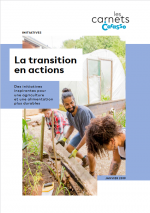 La transition en actions. Des initiatives inspirantes pour une agriculture et une alimentation plus durables
23 novembre 2021, par Mathilde COUDRAYCe document sur la Transition en actions présente des initiatives pour inspirer ceux qui souhaitent accélérer la transition sur leurs territoires. Les solutions présentées dans cet ouvrage sont des illustrations concrètes de démarches déjà mises en œuvre en France et en Espagne qui sont soutenus par la Fondation Daniel et Nina Carasso.
-
 Lisa Gerbal
25 mars 2020, par Mathilde COUDRAYLe PAEN, une innovation dans la protection du foncier agricole et le soutien à l’agriculture dans l’Hérault ?
-
 Rapport du groupe de travail « Enseigner la transition écologique dans le supérieur »
23 novembre 2021, par Mathilde COUDRAYRecommandations formulées par le groupe de travail pour la mise en œuvre opérationnelle de la mission "Enseigner la transition écologique dans le supérieur"
-
 Léa Gelb
2 juillet 2020, par Mathilde COUDRAYMOTS-CLÉS : BLOCKCHAIN, TRAÇABILITÉ, TRANSPARENCE, CHAÎNES DE VALEUR, CONFIANCE
L’application de la technologie blockchain aux filières alimentaires résulte de la nécessité de réduire deux problèmes majeurs auxquels sont confrontées les chaînes d’approvisionnement alimentaire : l’opacité et la gravité des fraudes. Ces problèmes ont par exemple été illustrés par la célèbre affaire du Fipronil ayant touché l’Europe : des œufs contaminés dont la source a été trouvée trois mois après le déclenchement du scandale. En (...) -
 Marylène Lirvat
25 mars 2020, par Mathilde COUDRAYLieU’topie, une association de gouvernance participative
-
 Justine Dahmani
25 mars 2020, par Mathilde COUDRAYVRAC, un réseau de groupements d’achats pour favoriser l’accès au plus grand nombre à des produits de qualité