Home > Publications > Policy Briefs > 34 / From lived experiences to public policy: rethinking the fight against (…)
In low-and middle-income countries, undernutrition and overweight/obesity coexist, reflecting an increasingly complex nutritional landscape. Progress in curbing undernutrition and its impacts (stunted growth, wasting, underweight, micronutrient deficiencies) remains slow, whilst overweight and obesity continue to increase. The double burden of malnutrition (DBM) is an epidemiological and biological phenomenon stemming from common determinants, primarily poor diet.
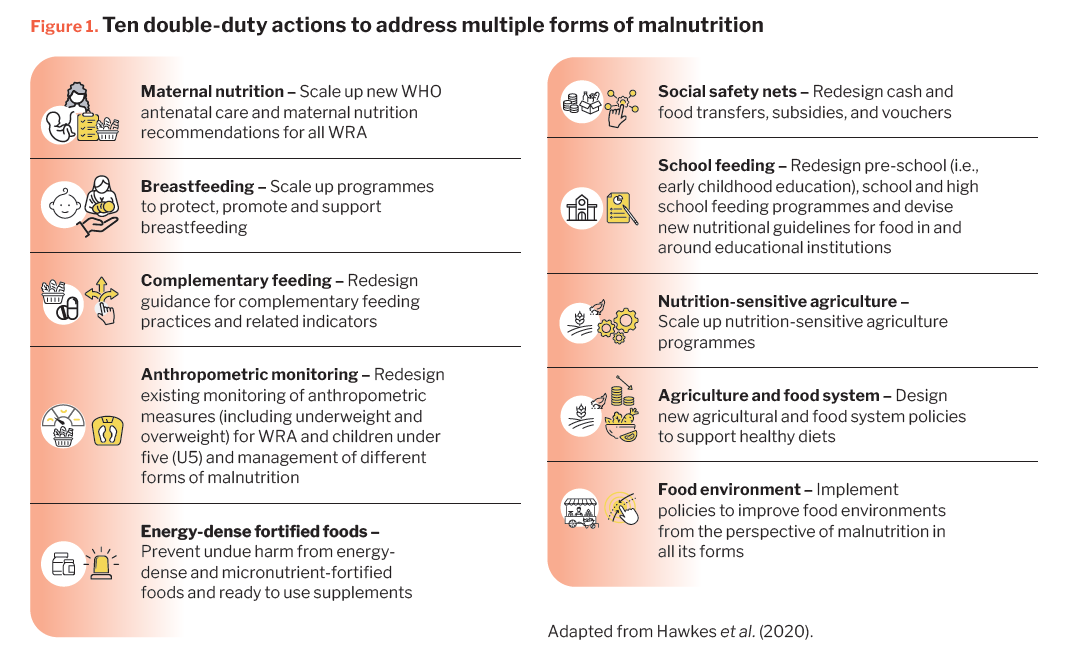
These two forms of malnutrition have historically been treated as separate problems. In light of this, recent work by the World Health Organisation (WHO) highlights the need to replace this compartmentalised approach with so-called ‘double-duty actions’ designed to simultaneously prevent multiple forms of malnutrition. In 2017, the WHO identified five priority actions to combat the DBM. This framework was subsequently expanded to ten ‘double-duty actions’, presented in a paper published in The Lancet (1) and calling for a joint mobilisation of the health, education, social protection and agriculture sectors (Figure 1).
Despite a reduction in undernutrition, Ethiopia continues to face high rates of stunting among children under five, anaemia among children and women, and a rising prevalence of overweight and obesity, particularly among women in urban areas (2,3). Policies and funding nevertheless remain largely focused on combating undernutrition, leaving emerging nutritional dynamics linked to urbanisation and changing food environments partly overlooked.
The TAckling Multiple forms of Malnutrition In Ethiopia amongst women of reproductive age and children under five (TAMMIE) project combines an analysis of women’s lived experiences around diets and the constraints they face in urban areas, with epidemiological analysis, policy and stakeholder mapping, and a participatory prioritisation of actions, carried out with institutional stakeholders. This approach aims to document the drivers of unhealthy diets and DBM, and to shed light on the conditions for its institutional management.
The project utilised participatory photography (Photovoice) with urban women in Addis Ababa. Five groups of participants from different socio-economic backgrounds (ranging from low-income to more affluent) were invited to use photography to document the barriers they faced in adopting a healthy diet for themselves and their children. These images then formed the basis for structured group discussions.
The use of images is one of the specific contributions of Photovoice compared with traditional qualitative methods centred on discourse (4). Images serve to make issues visible, helping to bridge the gap between decision-making and lived realities. Decision-makers were thus confronted with the tangible nature of domestic and environmental constraints—inadequate kitchen facilities, poor-quality equipment and precarious living conditions in certain neighbourhoods—of which they did not necessarily have a concrete understanding.
The method furthermore enabled more participant involvement. In addition to identifying and analysing the needs and difficulties encountered, the women also jointly developed and prioritised solutions, thereby strengthening their agency and opening up a space for discussion that is rarely available in their daily lives. They not only expressed their lived experiences but also produced a context-specific analysis of the factors influencing the adoption of a healthy diet, whilst jointly developing potential solutions tailored to their circumstances.
Finally, the women’s photographs and accounts were featured in an exhibition during the presentation of the findings to decision-makers, accompanied by a compilation of the images in a booklet. During this presentation, the decision-makers were invited to respond to the photographs by identifying the priority issues to be addressed and suggesting possible solutions, thereby laying the groundwork for prioritisation exercises.
Beyond socio-economic differences, discussions with women point to several factors considered crucial to ensure access to a healthy diet. Across all groups, the barriers identied stem primarily from structural constraints rather than insufficient nutritional knowledge. Limited financial resources to access healthy foods, unequal access to food outlets, heavy unpaid care and domestic responsibilities, and chronic time constraints restrict people’s capacity to make healthier food choices. These barriers are further compounded by gender inequalities that limit women’s decision-making power and budgetary autonomy.
Women do not emphasise individual behavioural changes; on the contrary, they call for transformations in their physical, economic and social environment. In the most disadvantaged communities, where constraints appear most severe, the solutions lie almost exclusively in public action. The issues raised include the creation of jobs and stable incomes, access to healthy food at affordable prices, the expansion of childcare services, and improvements to domestic infrastructure.
Among more affluent groups, whilst material constraints are less pronounced, the food environment is nonetheless perceived as unfavourable. Participants described the presence, in retail outlets, of foods of poor nutritional quality, backed by aggressive advertising strategies that influence consumer choices. Here too, regulating the advertising and commercial supply of unhealthy foods and beverages appears to be a key lever for change. This group of women identified more initiatives at community or household level: the development of community gardens, local mutual aid, solidarity-based lending schemes, and support for urban agriculture. These initiatives reflected greater scope for action than that of the group of women from more modest backgrounds.
This need to address the structural determinants of access to a healthy diet with prevailing policy approaches, which remain largely centred on nutrition education and individual responsibility. From the women’s perspective, information alone, without favourable material conditions, remains ineffective.
The proposals put forward by the participants call for a shift in focus, from behavioural change towards the transformation of food environments — including within the home (cooking, storage and preservation conditions) — and for the recognition of malnutrition as a systemic problem. This is particularly important in low-income urban contexts, which remain insufficiently addressed by public policies that continue to prioritise rural areas. In the neighbourhoods studied, women struggle to identify programmes that could improve their situation.
The TAMMIE project set out to analyse how double-duty actions are adopted, prioritised and implemented within the Ethiopian national context, by engaging various stakeholders: government, academic and civil society organisations, and international bodies. This analysis was based on a mixed-method approach combining the prioritisation and evaluation of double-duty interventions, as well as a mapping of stakeholder networks to identify the key players involved in implementing these interventions.
Participants were asked to rank ten double-duty actions according to four criteria (impact, feasibility, social acceptability and cost), and then to explore these trade-offs in greater depth during individual interviews focusing on five double-duty actions deemed to be priorities.
Interventions promoting breastfeeding, maternal nutrition and nutrition-sensitive agriculture were widely favoured as a means of combating DBM, due to their perceived impact, feasibility, cost-effectiveness and
socio-cultural relevance. Conversely, school feeding programmes and anthropometric monitoring were considered more restricted, due to high costs, logistical challenges, limited political support and perceived limited effectiveness.
An analysis of the proposals put forward by the women participating in the project highlights the limitations of this segmented approach, which involves isolating an intervention that is assumed to act independently on
DBM. Double-duty actions are not independent levers, but rather form part of a system of complementary interventions operating at both the individual and environmental levels. The challenge therefore lies in defining context-specific strategic combinations capable of linking, for example, maternal nutrition, social safety nets, and changes to the food environment. In other words, combating the multiple forms of malnutrition calls for an approach based on ‘clusters of interventions’ rather than isolated priorities.
Coordinating such clusters requires integrated governance capable of bringing together actors with different expertise and mandates. However, the relational mapping carried out as part of the project—which analyses the links of influence, funding, collaboration and information sharing between ministries, public agencies, international donors, UN organisations, NGOs and academic institutions—highlights a dense institutional ecosystem, structured around a central role for the state (the Ministries of Health and Agriculture) and significant support from technical and financial partners. This configuration is still characterised by overlapping responsibilities and sectoral fragmentation of public policies. All these factors contribute to the existence of an institutional bottleneck in the implementation of double-duty actions. Conversely, these actions rely on effective intersectoral coordination—understood as the organic and institutionalised coordination of the health, education, urban planning, agriculture and social protection sectors—centred on a common goal: the reduction of various forms of malnutrition. The effectiveness of double-duty actions thus depends less on their intrinsic relevance alone than on their cross-sectoral steering and governance. The recommendations put forward by decision-makers—such as the creation of a national nutrition council or an interministerial steering committee—are in line with this approach.
The results of the TAMMIE project show that addressing the double burden of malnutrition requires a more integrated approach to nutrition governance, combining institutional expertise, sectoral coordination and experiential knowledge. The challenge is therefore to involve the individuals concerned—in this case, women —in an effective and structured way in the consultation processes that precede the development of policies to combat malnutrition. To this end, formalised dialogue mechanisms, such as Community Labs, can be established. Defined as institutionalised spaces for co-creation that bring together citizens, researchers and public decision-makers to address a specific problem, they aim to generate solutions rooted in local realities, to test their feasibility and, where appropriate, to support their scaling up. This type of approach is beginning to take shape in Ethiopia, notably through the Seqota Declaration, which aims to end stunting. Whilst these practices are not yet the norm, they reveal a growing dynamic of participation, in which the voices of women —who are particularly vulnerable to malnutrition—could be recognised as a strategic resource for public policy.
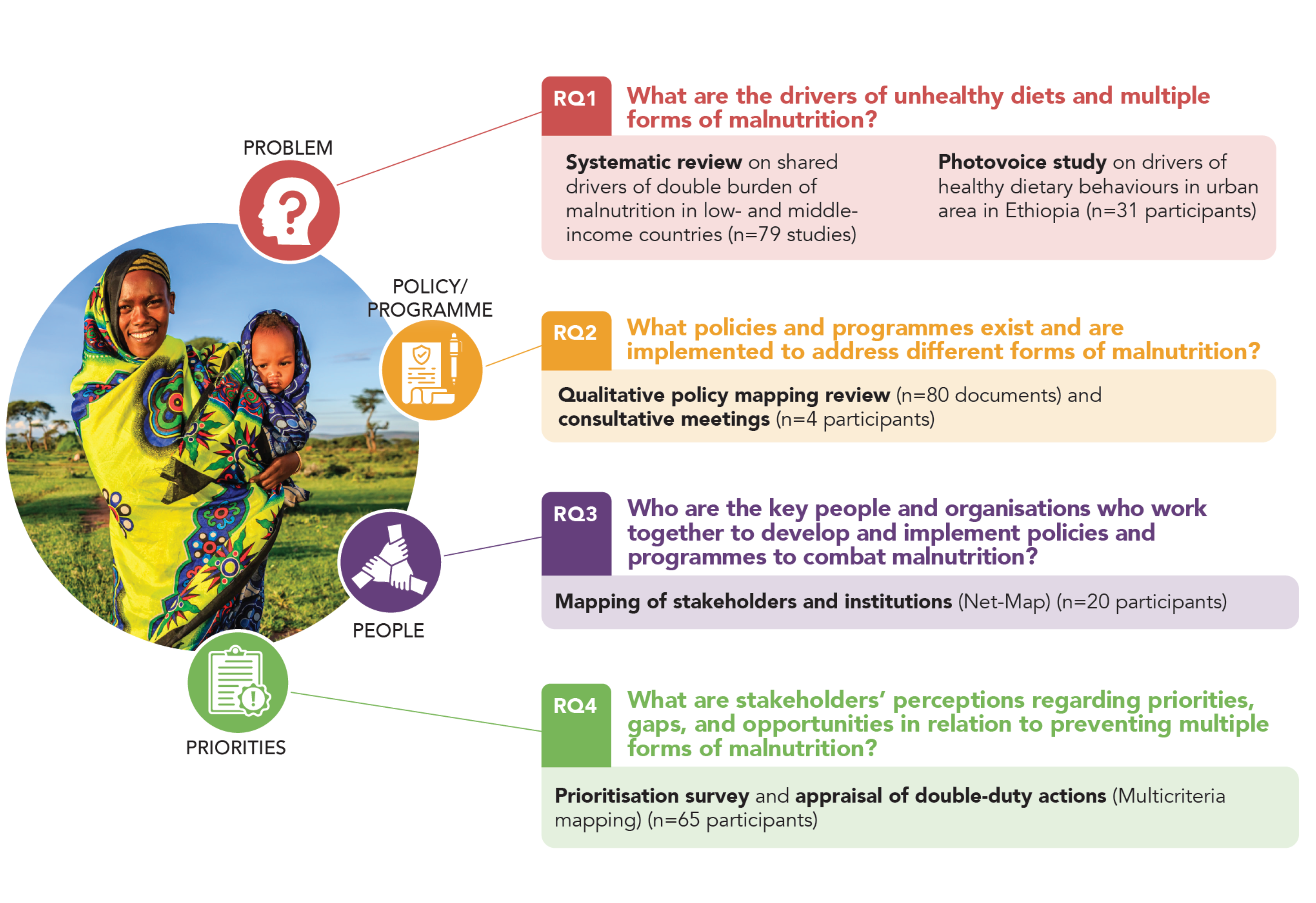
The TAMMIE project analyses the double burden of malnutrition among women of reproductive age and children under five in Ethiopia, drawing on a 4P conceptual framework: Problem, Policies/Programmes, People and Priorities (Figure 2). It assesses the causes (RQ1) and develops a roadmap to address them by analysing existing policies and programmes (RQ2), the stakeholders involved (RQ3) and the priorities for intervention (RQ4). This interdisciplinary approach combines epidemiological data, public policy analysis, participatory surveys and multi-stakeholder consultation to bridge the gap between scientific understanding and public decision-making. Here, we present the results derived from three methodologies: Photovoice, Multicriteria Mapping (MCM), and stakeholder network mapping (Net-Map). The Photovoice method, or participatory photography, was carried out in Addis Ababa with 31 women from a variety of socio-economic backgrounds. Invited to photograph the barriers to healthy eating for themselves and their children, the participants then discussed their images together as a group. At the same time, in-depth interviews were conducted with 86 stakeholders (from ministries, universities, research institutes, international organisations, NGOs, donors and the private sector). This consultation enabled the prioritisation and evaluation of actions aimed at tackling the double burden of malnutrition (DBM) and the mapping of these stakeholders’ networks (Net-Map).
Hawkes, C., Ruel, M.T., Salm, L., Sinclair, B., Branca, F., 2020. Double-duty actions: seizing programme and policy opportunities to address malnutrition in all its forms. The Lancet 395, 142–155.
Ethiopian Public Health Institute (EPHI). 2025. Ethiopia Food and Nutrition Strategy Baseline Survey 2021–2022. Addis Ababa, Ethiopia: Ethiopian Public Health Institute.
Ethiopian Statistical Service (ESS) and ICF. 2025. Ethiopia Demographic and Health Survey 2024–25: Key Indicators. Addis Ababa and Rockville, Maryland, USA: ESS and ICF.
Lepiller, Olivier et al. (eds), Studying Food and Eaters: A cocktail of Perspectives and Methods. Versailles, éditions Quæ, 2021. Chapter 7: Photovoice: a participatory method to explore food environments from inhabitants’ viewpoint.
Read online